

A clear, evidence-based guide for adults wondering whether ADHD may explain lifelong challenges with attention, organization, time management, and follow-through.
Evidence-Based Guide • About a 20-Minute Read
If you’ve ever wondered why staying organized, following through, managing time, or keeping up with everyday responsibilities feels harder than it seems to for other people, you’re in the right place.
For many adults, these challenges are frustrating—but difficult to explain. Some have spent years believing they simply need to become more disciplined, more organized, or better at managing their time. Others have learned to compensate so well that no one, including themselves, ever considered ADHD.
The truth is that adult ADHD is often misunderstood, frequently overlooked, and highly treatable when accurately diagnosed.
This guide was created to provide a clear, evidence-based understanding of adult ADHD—what it is, why it often goes unrecognized until adulthood, how clinicians make the diagnosis, and what today’s treatment options look like.
Whether ADHD ultimately explains your experiences or not, our hope is that you’ll leave with something every person deserves:
A better understanding of yourself.
What You’ll Learn
- Why adult ADHD is often missed until later in life
- How executive function affects work, relationships, and everyday responsibilities
- What happens during a comprehensive ADHD evaluation
- How clinicians determine whether ADHD is the right diagnosis
- The evidence behind today’s treatment options
- When it may be appropriate to consider an ADHD evaluation
Before We Begin
If you’ve found your way to this guide, you’re probably looking for more than information.
You’re looking for an explanation.
Perhaps you’ve spent years wondering why staying organized, following through on important tasks, or managing everyday responsibilities seems to require so much more effort than it does for other people.
Maybe someone close to you suggested learning more about ADHD.
Perhaps your child was recently diagnosed, and you began recognizing parts of your own story.
Or maybe you’ve simply reached a point where you’re tired of wondering whether there’s a reason life has always felt harder than it seemed like it should.
Whatever brought you here, welcome.
I created this guide because I believe adults deserve better information about ADHD than they often find online.
Today, it’s easy to find short videos, personality quizzes, and social media posts that oversimplify ADHD. Some suggest that every distracted adult has ADHD. Others dismiss it altogether.
Neither approach helps people who are genuinely looking for answers.
The reality is more nuanced.
Adult ADHD is a well-studied neurodevelopmental condition that can affect attention, executive functioning, relationships, work, finances, and many other aspects of daily life. At the same time, anxiety, depression, sleep disorders, trauma, medical conditions, and chronic stress can produce symptoms that look remarkably similar.
That’s why understanding ADHD is important.
But understanding yourself accurately is even more important.
After evaluating adults with concerns about ADHD, I’ve learned that most people aren’t looking for a diagnosis.
They’re looking for an explanation.
They want to understand why certain aspects of life have always seemed more difficult than they appeared to be for everyone else.
Some ultimately learn that ADHD explains those lifelong patterns.
Others discover a different explanation.
Either outcome is valuable because the goal has never been to place a label on someone’s experiences.
The goal is to understand them accurately.
That’s the purpose of this guide.
Over the pages that follow, we’ll explore what adult ADHD is, why it often goes unrecognized until later in life, how clinicians make the diagnosis, what evidence-based treatment looks like, and how to decide whether a comprehensive evaluation is the right next step.
You don’t need to diagnose yourself as you read.
You don’t need to decide today whether ADHD explains your experiences.
You simply need to remain curious.
If this guide helps replace uncertainty with understanding, then it has accomplished exactly what it was created to do.
Let’s begin.
Why Do So Many Adults Begin Wondering About ADHD Later in Life?
For many adults, the question isn’t:
“What is ADHD?”
The question is:
“Why does life feel harder than it seems like it should?”
That question often develops gradually.
You may notice you’re working longer hours just to keep up. You miss deadlines despite genuinely caring about your work. You start projects with enthusiasm but struggle to finish them. You forget appointments, lose track of conversations, or feel overwhelmed by tasks that other people seem to manage without much effort.
At first, it’s easy to blame yourself.
Maybe you tell yourself you need to become more organized.
More disciplined.
Better at managing your time.
So you buy another planner, download another productivity app, or promise yourself that this time you’ll finally stay on top of everything.
Sometimes those strategies help.
But as responsibilities grow—with a more demanding career, raising children, caring for aging parents, or simply managing the complexity of adult life—they often stop being enough.
One of the things I’ve observed while evaluating adults is that very few people come to an appointment asking for an ADHD diagnosis.
Most come because they’re tired of wondering why life feels more difficult than they believe it should.
For some, the question begins after a child is diagnosed with ADHD. Others hear a spouse, friend, therapist, or primary care clinician ask, “Have you ever considered that this could be ADHD?” Still others discover that treatment for anxiety, depression, or burnout improves part of the picture but never fully explains the lifelong pattern of challenges they’ve experienced.
Many adults are surprised to learn that ADHD can remain unrecognized for decades. Current diagnostic guidelines recognize that ADHD commonly persists into adulthood, and research has shown that delayed diagnosis is particularly common among women, adults with predominantly inattentive symptoms, and individuals who developed effective compensation strategies that masked their difficulties earlier in life (American Psychiatric Association, 2022; Faraone et al., 2021).
Recognizing yourself in these experiences does not mean you have ADHD.
Difficulty concentrating, procrastination, forgetfulness, and feeling overwhelmed can occur for many reasons, including anxiety, depression, sleep disorders, chronic stress, medical conditions, and major life transitions.
That’s why understanding ADHD is only the first step.
Determining whether ADHD is actually the right diagnosis requires a thoughtful, comprehensive evaluation.
This guide was created to help you understand what adult ADHD is, how clinicians diagnose it, what evidence-based treatment looks like, and how to decide whether pursuing an evaluation is the right next step for you.
Let’s begin by answering a question that surprises many adults:
If ADHD can affect someone’s life so profoundly, why does it so often go unrecognized until adulthood?
Why Adult ADHD Often Goes Unrecognized
If ADHD can significantly affect a person’s education, career, relationships, and daily life, why do so many adults reach their 30s, 40s, or even later before anyone considers the diagnosis?
The answer is that adult ADHD often doesn’t look the way most people expect it to.
For many years, ADHD was viewed primarily as a childhood disorder affecting boys who were constantly moving, interrupting the classroom, or struggling academically. While that presentation certainly exists, it represents only one expression of ADHD. The Diagnostic and Statistical Manual of Mental Disorders (5th ed., text rev.; DSM-5-TR) recognizes that ADHD frequently persists into adulthood, where symptoms often present differently than they do in childhood (American Psychiatric Association, 2022).
Adults are less likely to be running around a classroom.
Instead, they may struggle to organize competing priorities, manage time effectively, initiate important tasks, follow through on responsibilities, or keep up with the growing demands of work, family, and everyday life.
Because these challenges are largely invisible, many adults become remarkably good at compensating.
They rely on calendars, reminders, detailed to-do lists, color-coded planners, and last-minute deadlines to stay organized. Others become perfectionists, spending far more time preparing than their peers because they fear forgetting something important.
From the outside, these strategies often look like success.
What others don’t see is how much effort it takes to maintain them.
For many adults, those systems work for years—until they don’t.
A promotion at work.
The birth of a child.
Graduate school.
Caring for aging parents.
A major life transition.
As responsibilities increase, the strategies that once kept everything together may no longer be enough.
Researchers have found that delayed diagnosis is common among adults whose symptoms were less disruptive during childhood, particularly women, adults with predominantly inattentive symptoms, and individuals who developed effective coping strategies that masked their difficulties earlier in life (Faraone et al., 2021; Young et al., 2020).
One of the unfortunate consequences of compensating so effectively is that many adults begin blaming themselves instead of questioning whether there might be another explanation.
“I’m just disorganized.”
“I need better self-discipline.”
“Everyone else seems to manage life better than I do.”
After hearing these thoughts for years, they can begin to feel like facts rather than self-criticism.
From My Practice
One of the most common things I hear during an ADHD evaluation is:
“I’ve spent my entire life thinking I just wasn’t trying hard enough.”
That statement is rarely about effort.
Most adults seeking an evaluation have spent years working incredibly hard to compensate. They’re often successful professionals, dedicated parents, or dependable employees who have quietly developed elaborate systems just to keep up with daily responsibilities.
They’re not looking for an excuse.
They’re looking for an explanation.
Another reason ADHD is frequently overlooked is that it often occurs alongside other conditions. Anxiety, depression, sleep disorders, trauma, chronic stress, and substance use disorders can all affect attention and executive functioning. A careful evaluation considers each of these possibilities because they may coexist with ADHD—or provide a more accurate explanation for a person’s symptoms (National Institute for Health and Care Excellence [NICE], 2018).
This is why a comprehensive ADHD evaluation asks a broader question than simply,
“Do you have ADHD?”
It asks,
“What best explains the lifelong pattern of your strengths, challenges, and experiences?”
That distinction is one of the reasons a thoughtful evaluation is so valuable.
Now that we’ve explored why ADHD is often missed, the next step is understanding what ADHD actually is—and why it affects so much more than attention alone.
Executive Function: The Missing Piece That Explains Adult ADHD
Imagine it’s Saturday morning.
You sit down with a cup of coffee and one simple goal:
Pay a bill that’s due next week.
You open your laptop.
Before you can log in, you notice an email you’ve been meaning to answer.
While reading the email, you remember you forgot to refill a prescription.
You pick up your phone to call the pharmacy.
A text message comes in.
Then you remember the laundry.
Twenty minutes later, you’re reorganizing a kitchen drawer.
The bill is still unpaid.
It isn’t because you don’t care.
It isn’t because you’re lazy.
And it isn’t because you don’t understand what needs to be done.
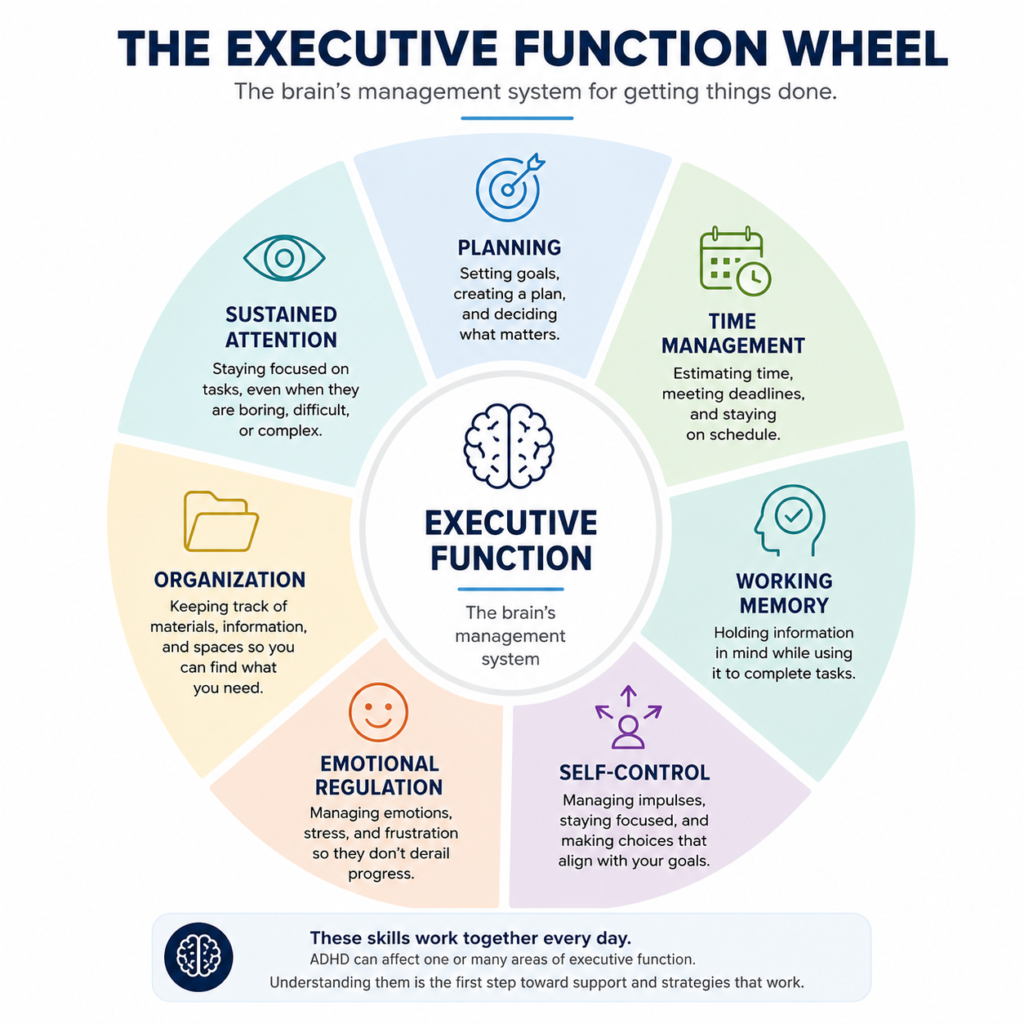
For many adults with ADHD, the challenge lies in something called executive function.
What Is Executive Function?
Executive function is the brain’s management system.
Rather than representing a single skill, executive function is a collection of mental processes that help us organize, prioritize, plan, remember information, regulate emotions, manage time, shift attention, and translate intentions into action (American Psychiatric Association, 2022; Barkley, 2012).
Think of it this way.
Your brain may generate excellent ideas.
Executive function helps turn those ideas into consistent action.
When executive function works well, many everyday tasks happen almost automatically.
You remember appointments.
You estimate how long a project will take.
You switch between responsibilities without losing track of what you were doing.
You begin tasks that aren’t especially interesting because you know they still need to be done.
Most of us don’t think about executive function because it works quietly in the background.
When it doesn’t work efficiently, however, everyday life can begin to feel far more difficult than it appears to be for other people.
ADHD Is About More Than Attention
One of the biggest misconceptions about ADHD is that it’s simply a disorder of paying attention.
In reality, attention is only one part of a much larger picture.
Many adults with ADHD can focus exceptionally well on activities that are interesting, novel, urgent, or personally meaningful.
They may spend hours immersed in a creative project, a favorite hobby, or solving a complex problem.
The difficulty often isn’t whether they can pay attention.
It’s when and how they can direct their attention.
This is one reason ADHD is better understood as a condition affecting executive functioning rather than a simple inability to focus (Barkley, 2012).
A Different Way of Understanding ADHD
For many adults, learning about executive function changes the conversation.
Instead of asking,
“Why can’t I make myself do this?”
they begin asking,
“What is making this task so difficult for my brain to manage?”
That shift doesn’t eliminate responsibility.
It eliminates unnecessary shame.
Understanding executive function doesn’t excuse missed deadlines or forgotten commitments.
It provides a framework for understanding why those struggles occur—and why effective treatment focuses on improving executive functioning rather than simply telling people to “try harder.”
From My Practice
One of the moments I enjoy most during an ADHD evaluation is when someone realizes they’ve been measuring themselves by the wrong standard.
They’ve spent years believing they lacked motivation or discipline.
Then they begin to understand that many of their challenges are better explained by differences in executive functioning.
That realization doesn’t solve every problem.
But it often replaces years of self-criticism with a healthier question:
“Now that I understand what’s happening, what can I do about it?”
The answer begins by looking at how executive function affects everyday life.
How ADHD Affects Everyday Life
Understanding executive function helps explain why ADHD affects so many different areas of life.
Executive function isn’t something you use only at work or school.
It’s involved in hundreds of small decisions throughout the day.
Getting out the door on time.
Remembering to return a phone call.
Paying bills before they’re due.
Following through on household tasks.
Starting a project you’ve been avoiding.
Shifting your attention when priorities change.
Because executive function influences so many everyday activities, ADHD often affects much more than attention alone.
At Work
Many adults with ADHD are highly intelligent, creative, and capable.
Their greatest challenge usually isn’t knowing what needs to be done.
It’s consistently deciding where to begin, what deserves attention first, and how to stay focused long enough to finish.
You may spend an hour responding to emails while the most important project remains untouched.
Not because the project isn’t important.
Because getting started feels unexpectedly difficult.
Others find themselves doing their best work under intense deadline pressure because urgency temporarily provides the structure their brain struggles to create on its own.
These challenges reflect differences in executive functioning rather than a lack of intelligence or ambition (Barkley, 2012).
At Home
Home often becomes the place where executive function is tested the most.
Laundry.
Groceries.
Appointments.
Household chores.
Meal planning.
Paying bills.
Replacing items before they run out.
None of these responsibilities are especially difficult on their own.
Together, however, they require constant planning, organization, prioritization, and follow-through.
Many adults describe feeling overwhelmed not by one large responsibility, but by hundreds of small ones competing for their attention.
In Relationships
ADHD can also affect relationships in ways that are often misunderstood.
A forgotten conversation.
An unfinished household project.
Arriving late despite good intentions.
Forgetting an anniversary or an important errand.
To a partner, these experiences may appear to reflect a lack of caring.
For the person with ADHD, they often reflect difficulty managing attention, working memory, and competing priorities—not a lack of love or commitment.
Understanding that difference can change the conversation from blame to problem-solving.
Time Often Feels Different
Many adults with ADHD describe a lifelong struggle with time.
A task they expected to take ten minutes requires an hour.
An hour disappears without warning.
Deadlines that once seemed far away suddenly arrive.
This experience is sometimes described as time blindness—difficulty accurately sensing the passage of time and estimating how long activities will take. While “time blindness” is not a formal diagnostic term, it reflects a common experience reported by many adults with ADHD and is closely related to executive functioning (Barkley, 2012).
Emotional Regulation
Many people are surprised to learn that ADHD may also affect emotional regulation.
Small frustrations can feel disproportionately intense.
Interruptions may be unusually difficult to tolerate.
Criticism can linger far longer than expected.
Although emotional dysregulation is not included among the formal DSM-5-TR diagnostic criteria for ADHD, a growing body of research recognizes it as a common feature that can significantly affect quality of life (American Psychiatric Association, 2022; Faraone et al., 2021).
The Bigger Picture
Everyone procrastinates.
Everyone forgets appointments.
Everyone becomes distracted.
Those experiences are part of being human.
What distinguishes ADHD is not the presence of individual symptoms.
It’s the pattern.
The challenges tend to begin early in life, occur across multiple settings, persist over time, and interfere with everyday functioning.
That pattern—not any single behavior—is what clinicians evaluate when determining whether ADHD is the most accurate diagnosis.
In the next section, we’ll look at how clinicians bring all of those pieces together during a comprehensive ADHD evaluation.
What Happens During a Comprehensive ADHD Evaluation?
By this point, you may recognize yourself in many of the experiences we’ve discussed.
You may even be wondering whether ADHD could explain some of the challenges you’ve experienced throughout your life.
But recognizing yourself in an article is not the same as receiving a diagnosis.
That’s why a comprehensive ADHD evaluation is so important.
Its purpose isn’t simply to answer the question,
“Do you have ADHD?”
It’s to answer a more important question:
“What is the most accurate explanation for what you’ve been experiencing?”
ADHD Is a Clinical Diagnosis
Unlike diabetes or high blood pressure, there is no blood test, brain scan, or imaging study that can confirm ADHD.
Instead, clinicians diagnose ADHD by combining a detailed clinical interview, established diagnostic criteria, developmental history, and an assessment of how symptoms affect everyday functioning (American Psychiatric Association, 2022).
The diagnosis comes from understanding the entire picture—not from any single test.
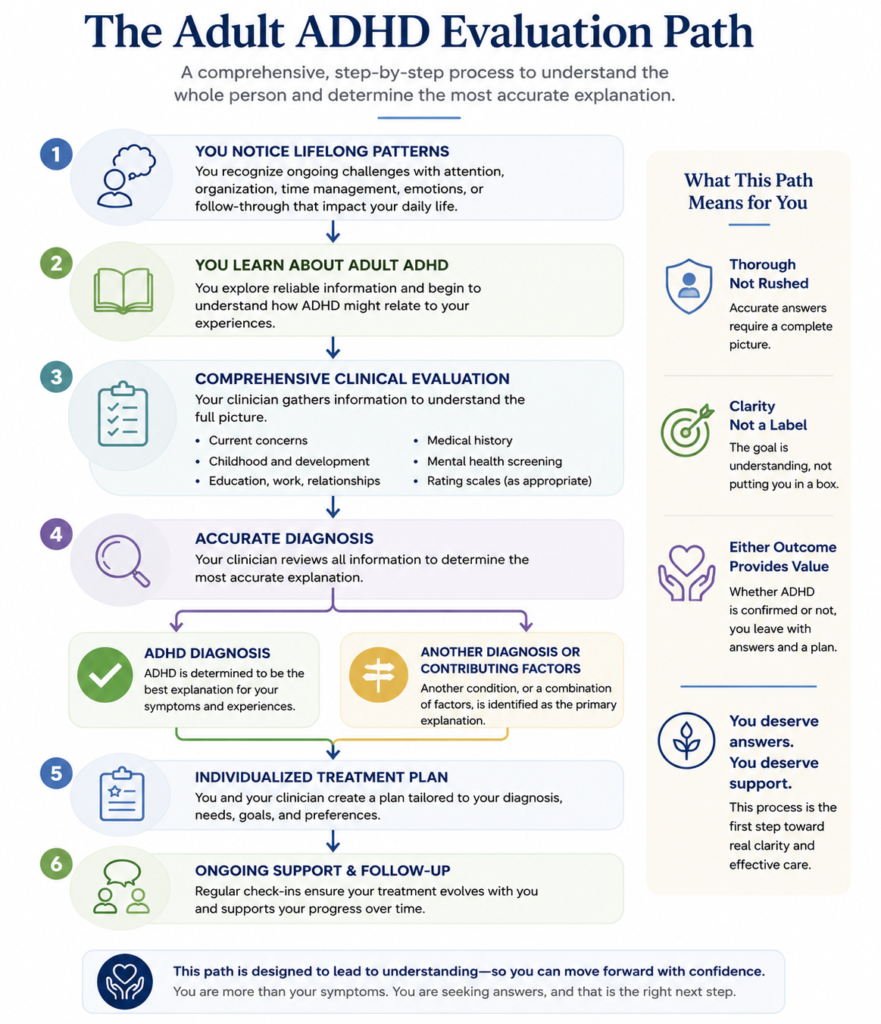
A comprehensive ADHD evaluation is a thoughtful, step-by-step clinical process designed to understand the whole person—not simply confirm or rule out ADHD. The goal is to identify the most accurate explanation for your experiences and develop an individualized treatment plan.
A Comprehensive Evaluation Looks at the Whole Person
A thorough ADHD evaluation typically includes:
- Your current concerns and the situations where they occur.
- A review of childhood experiences and developmental history.
- Educational, occupational, and relationship history.
- Medical history and current medications.
- Screening for anxiety, depression, trauma, sleep disorders, substance use, and other conditions that can affect attention and executive functioning.
- Standardized rating scales, when appropriate, to provide additional information.
Each piece contributes to understanding the broader pattern of your experiences.
Why Childhood History Matters
One of the DSM-5-TR diagnostic requirements is that several symptoms must have been present before the age of 12, even if they weren’t recognized as ADHD at the time (American Psychiatric Association, 2022).
Many adults initially worry because they don’t remember having ADHD as children.
That’s common.
The goal isn’t to prove that you were “the hyperactive child.”
It’s to determine whether the challenges you’re experiencing today reflect a lifelong pattern that began during childhood.
Sometimes that history comes from your own memories.
Sometimes family members provide helpful insights.
Sometimes school records reveal patterns that make more sense when viewed through the lens of ADHD.
Looking Beyond ADHD
One of the most important parts of a comprehensive evaluation is considering other possible explanations.
Difficulty concentrating is not unique to ADHD.
It can also occur with anxiety disorders, depression, sleep disorders, trauma, thyroid disease, medication side effects, chronic stress, and many other medical or psychiatric conditions.
In some cases, ADHD and another condition occur together.
In others, ADHD is not the correct diagnosis.
This process—called a differential diagnosis—is one of the most important responsibilities of an experienced clinician because the right treatment depends on making the right diagnosis (National Institute for Health and Care Excellence [NICE], 2018).
From My Practice
One question I often hear is:
“Can you tell if I have ADHD during my first appointment?”
Sometimes the answer is yes.
Sometimes the answer is no.
A careful evaluation isn’t about reaching the fastest conclusion.
It’s about reaching the most accurate one.
I’ve found that patients appreciate taking the time to understand the full picture rather than feeling rushed toward a diagnosis.
An accurate diagnosis provides a much stronger foundation for treatment than a quick answer ever could.
The Goal Isn’t a Label
Many people come to an ADHD evaluation hoping for certainty.
What they often leave with is something even more valuable:
Understanding.
Whether the evaluation confirms ADHD or points in another direction, its purpose is the same—to provide clarity and guide the next steps in care.
The next chapter explains how clinicians use the DSM-5-TR diagnostic criteria as one part of that comprehensive evaluation.
How Clinicians Determine Whether ADHD Is the Right Diagnosis
When clinicians evaluate someone for ADHD, they aren’t looking for one symptom or one difficult week.
They’re looking for a pattern.
The Diagnostic and Statistical Manual of Mental Disorders (5th ed., text rev.; DSM-5-TR) provides the diagnostic framework clinicians use to determine whether ADHD is the most appropriate diagnosis (American Psychiatric Association, 2022). But applying that framework requires much more than checking boxes on a symptom list.
Symptoms Alone Are Not Enough
Most adults occasionally forget appointments.
Everyone procrastinates.
Everyone loses focus during a long meeting.
Those experiences, by themselves, do not indicate ADHD.
What matters is the overall pattern.
Clinicians consider questions such as:
- Have these challenges been present for many years?
- Did they begin during childhood, even if they weren’t recognized at the time?
- Do they occur in more than one area of life, such as work, home, or relationships?
- Are they causing meaningful impairment in daily functioning?
- Could another condition better explain these symptoms?
It is the combination of these factors—not any single symptom—that helps determine whether ADHD is the correct diagnosis (American Psychiatric Association, 2022).
Looking for a Lifelong Pattern
One of the defining features of ADHD is that it is a neurodevelopmental disorder.
In other words, it begins early in life, even if it isn’t diagnosed until adulthood.
Adults often tell me,
“I didn’t think I had ADHD because I did well in school.”
Academic success does not rule out ADHD.
Many people succeed because they are highly intelligent, receive strong family support, develop effective coping strategies, or work much harder than others realize.
A clinician’s role is to look beyond accomplishments and understand how much effort it took to achieve them.
Understanding Impairment
Another important part of the evaluation is determining whether symptoms interfere with everyday life.
This doesn’t necessarily mean someone has failed academically or professionally.
Many adults with ADHD build successful careers.
Instead, impairment often looks like:
- Working significantly longer hours just to keep up.
- Missing deadlines despite strong effort.
- Chronic disorganization.
- Financial difficulties related to forgetfulness or impulsivity.
- Ongoing conflict in relationships because of missed responsibilities.
- Persistent stress from feeling as though life is harder than it should be.
These experiences often matter more than the number of symptoms on a checklist.
Clinical Judgment Matters
One of the reasons ADHD evaluations require clinical expertise is that symptoms rarely exist in isolation.
Two people may report the same difficulty concentrating for entirely different reasons.
One may have ADHD.
Another may be experiencing untreated anxiety.
A third may be chronically sleep deprived.
The symptom is similar.
The diagnosis—and therefore the treatment—is different.
This is why clinical judgment remains an essential part of the diagnostic process. Diagnostic criteria provide structure, but understanding the whole person is what leads to an accurate diagnosis (National Institute for Health and Care Excellence [NICE], 2018).
From My Practice
One of the biggest misconceptions I encounter is the belief that ADHD can be confirmed by answering “yes” to enough questions on a checklist.
Screening questionnaires can be very helpful.
They identify patterns that deserve further evaluation.
But they do not replace a comprehensive clinical assessment.
The goal isn’t simply to determine whether someone meets diagnostic criteria.
It’s to determine whether ADHD is the diagnosis that best explains that person’s lifelong experiences.
That distinction is what guides effective treatment.
Receiving an accurate diagnosis is an important milestone.
For many adults, however, the next question is just as important:
If I do have ADHD, what happens next?
What an ADHD Diagnosis Can Mean
For many adults, receiving an ADHD diagnosis answers a question they have been asking for years:
“Why has everyday life always seemed harder than it should?”
An accurate diagnosis doesn’t change who you are.
It doesn’t rewrite your past.
And it doesn’t define your future.
What it can do is provide a framework for understanding lifelong patterns that may never have made sense before.
Many adults describe feeling a sense of relief after learning that there may be a medical explanation for struggles they had long attributed to personal shortcomings.
Others experience mixed emotions.
They may feel validated while also reflecting on opportunities they believe they missed or years spent wondering why they had to work so much harder than everyone else.
Both reactions are understandable.
Qualitative studies of adults diagnosed later in life have found that many people experience a period of reinterpreting past experiences through a new lens, often describing both relief and grief as they make sense of their lives (Young et al., 2020).
A Diagnosis Is Not Your Identity
One of the biggest misconceptions about receiving an ADHD diagnosis is that it changes who you are.
It doesn’t.
Your intelligence.
Your creativity.
Your sense of humor.
Your resilience.
Your accomplishments.
Those qualities existed long before any diagnosis.
What changes is your understanding.
Instead of seeing years of struggle as evidence that you weren’t disciplined enough or weren’t trying hard enough, you may begin to understand that many of those challenges were influenced by differences in executive functioning.
That shift in perspective often reduces shame and creates space for healthier, more effective ways of approaching daily life.
Clarity Leads to Better Decisions
A diagnosis is valuable because it helps guide treatment.
Without an accurate diagnosis, it’s difficult to know which strategies—or which treatments—are most likely to help.
With a clear understanding of what you’re experiencing, you and your clinician can make informed decisions together.
That may include medication.
It may include therapy.
It may include coaching, organizational strategies, or lifestyle changes.
The treatment plan depends on your goals, your symptoms, your overall health, and your personal preferences.
From My Practice
One of the most rewarding moments during an evaluation is not telling someone they have ADHD.
It’s watching them begin to understand themselves with greater compassion.
Many adults have spent years describing themselves as lazy, careless, or unmotivated.
A thoughtful evaluation often replaces those labels with something much more useful:
Understanding.
Whether ADHD is confirmed or ruled out, my goal is the same—to help each person leave with greater clarity than they had when they arrived.
The Beginning of a New Conversation
Receiving an ADHD diagnosis is not the end of the process.
It’s the beginning of a new conversation about what is possible.
The encouraging news is that ADHD is one of the most well-studied conditions in psychiatry, and decades of research have shown that many adults experience meaningful improvements in functioning and quality of life with appropriate treatment (Cortese et al., 2018; Faraone et al., 2021).
The next step is understanding what effective treatment looks like—and how different treatment options work together to support long-term success.
What Does Effective ADHD Treatment Look Like?
Once ADHD has been accurately diagnosed, the next question is usually straightforward:
“What can I do about it?”
The encouraging news is that adult ADHD is one of the most well-studied conditions in psychiatry. Evidence-based treatments can help many adults improve attention, executive functioning, daily functioning, and overall quality of life (National Institute for Health and Care Excellence [NICE], 2018; Faraone et al., 2021).
Effective treatment, however, is not about “fixing” a person.
It’s about reducing the barriers that make everyday life more difficult than it needs to be.
The Goal of Treatment
Many people assume the goal of treatment is simply to improve concentration.
In reality, the goal is much broader.
Effective treatment helps people function more consistently in the areas of life that matter most.
For one person, that may mean finishing projects at work without constant deadline pressure.
For another, it may mean being more present with family, managing finances more consistently, or feeling less overwhelmed by everyday responsibilities.
Treatment should always be measured by meaningful improvements in daily life—not simply by changes in symptoms.
There Is No One-Size-Fits-All Treatment Plan
Every adult with ADHD has a unique combination of strengths, challenges, responsibilities, medical history, and personal goals.
That is why clinical guidelines recommend developing an individualized treatment plan rather than applying the same approach to everyone (National Institute for Health and Care Excellence [NICE], 2018).
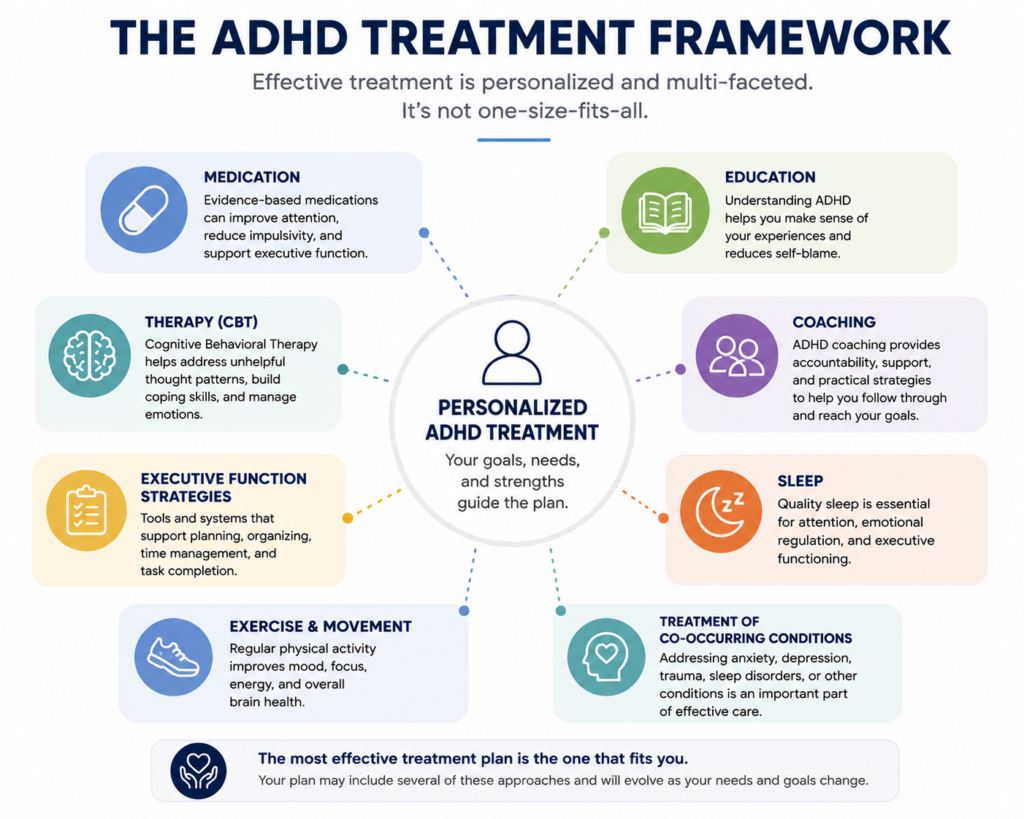
Effective ADHD treatment is personalized. Most adults benefit from a combination of evidence-based approaches—including medication, education, therapy, coaching, executive function strategies, healthy lifestyle habits, and treatment of co-occurring conditions—rather than any single intervention alone.
Depending on your needs, a comprehensive treatment plan may include one or more of the following:
- Medication
- Education about ADHD
- Cognitive behavioral therapy (CBT), or other therapy
- ADHD coaching
- Organizational and executive functioning strategies
- Sleep optimization
- Regular physical activity
- Treatment of co-occurring conditions such as anxiety or depression
The right combination depends on the individual—not the diagnosis alone.
Treatment Is a Process
One of the most important things to understand is that treatment is rarely a single decision.
It’s an ongoing process.
As life changes, treatment may need to change as well.
Someone starting a demanding new job may benefit from different strategies than someone returning to school, becoming a parent, or preparing for retirement.
The best treatment plans evolve as people’s lives evolve.
From My Practice
One of the first conversations I have with patients isn’t about medication.
It’s about goals.
What would make the biggest difference in your life?
What challenges frustrate you the most?
What would success look like six months from now?
Those answers help guide every treatment decision that follows.
The goal isn’t simply to reduce symptoms.
It’s to help people build lives that feel more manageable, more fulfilling, and more aligned with what matters most to them.
The Next Step
Medication is one of the most effective treatment options available for ADHD, but it is only one part of comprehensive care.
Understanding what medication can—and cannot—do is an important part of making informed decisions about treatment.
In the next section, we’ll explore how ADHD medications work, who may benefit from them, and some of the most common questions adults have when considering medication.
Understanding ADHD Medications
Medication is one of the most effective treatments available for ADHD.
It is also one of the most misunderstood.
Some adults worry that medication will change their personality.
Others worry about becoming dependent on it.
Some hope medication will solve every difficulty they’ve experienced for years.
The reality is more balanced than any of those assumptions.
Medication can be an important part of treatment for many adults with ADHD, but it is not the only treatment, nor is it the right choice for everyone (National Institute for Health and Care Excellence [NICE], 2018; Cortese et al., 2018).
The decision to use medication should always be made collaboratively between a patient and their clinician after considering the potential benefits, risks, medical history, lifestyle, and personal goals.
How ADHD Medications Help
Most medications used to treat ADHD work by improving the brain’s ability to regulate attention, executive functioning, and self-control.
Rather than giving someone abilities they never had, medication often helps people use their existing abilities more consistently.
Many adults describe being able to stay with a task more easily.
Others find it easier to organize their thoughts, begin important work, or transition between responsibilities without becoming overwhelmed.
The goal is not to create a different personality.
The goal is to reduce the barriers that make everyday life unnecessarily difficult.
Stimulant and Non-Stimulant Medications
Medications used to treat ADHD generally fall into two categories.
Stimulant medications are typically considered first-line treatment for many adults because they have been studied extensively and consistently demonstrate strong effectiveness for reducing core ADHD symptoms (National Institute for Health and Care Excellence [NICE], 2018).
Non-stimulant medications may be appropriate for adults who cannot tolerate stimulants, have certain medical conditions, experience significant side effects, or simply prefer another approach.
Choosing between these options depends on the individual.
There is no single medication that is “best” for everyone.
Medication Is One Tool
One of the most common misconceptions about ADHD treatment is that medication does all of the work.
It doesn’t.
Medication may improve attention and executive functioning.
It does not automatically create routines, improve communication, organize a calendar, or replace healthy habits.
Think of medication as making it easier to use the tools that help you succeed.
Those tools may include therapy, coaching, organizational systems, healthy sleep, regular exercise, and practical strategies that support executive functioning.
For many adults, those approaches work best together.
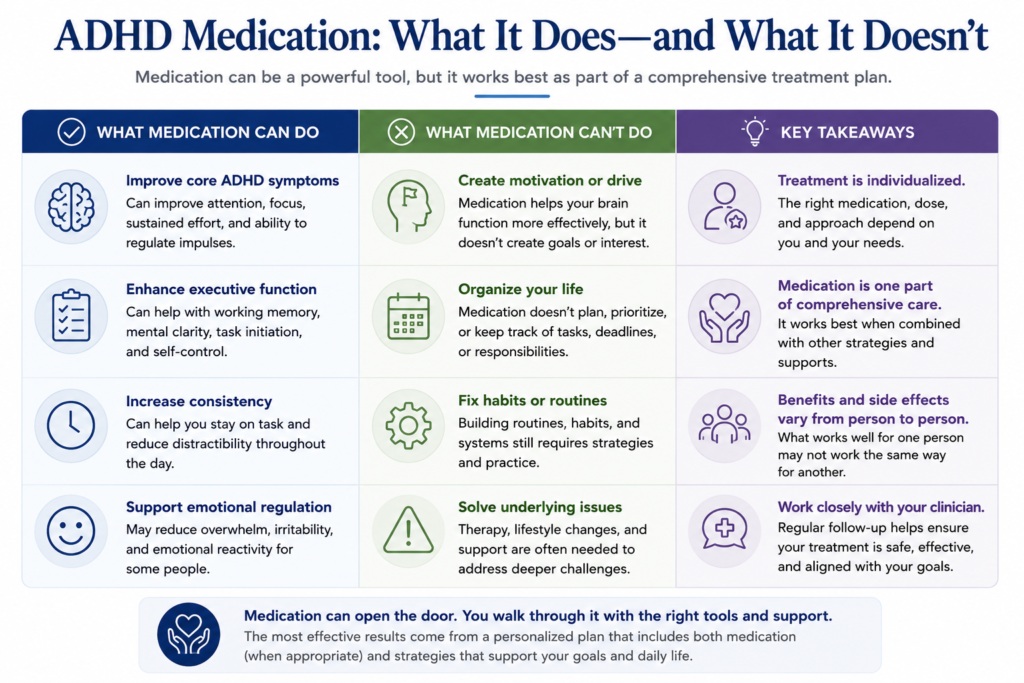
ADHD medication can be a highly effective part of treatment, but it works best as one component of a comprehensive, individualized care plan. This comparison highlights realistic expectations by showing both the benefits and the limitations of medication.
Safety Matters
Like all prescription medications, ADHD medications have potential benefits and potential risks.
Before recommending medication, clinicians consider your medical history, current medications, cardiovascular health, mental health history, and any other factors that may influence treatment decisions.
Once medication is started, ongoing follow-up helps ensure that treatment remains safe, effective, and aligned with your goals.
Medication is not simply prescribed and forgotten.
It is monitored, adjusted when needed, and regularly reviewed as part of your overall treatment plan.
From My Practice
One question I hear frequently is,
“Will medication change who I am?”
My goal is never to change who someone is.
It’s to help reduce the barriers that make it difficult for them to function the way they want to function.
When medication is appropriate and effective, many patients don’t tell me they feel like a different person.
They tell me they finally feel more like themselves.
Making an Informed Decision
Choosing whether to use medication is a personal decision.
For some adults, it becomes an important part of treatment.
For others, different approaches may be more appropriate.
The most important decision is not whether medication is “good” or “bad.”
It’s whether the treatment plan is supported by evidence, individualized to your needs, and developed through a thoughtful conversation with your clinician.
Medication is only one piece of successful ADHD care.
The next step is learning how therapy, coaching, and practical strategies can help turn improved attention into lasting change.
Building a Life That Works With Your Brain
One of the most encouraging things about ADHD treatment is that meaningful improvement rarely depends on a single intervention.
Instead, long-term success usually comes from combining evidence-based treatments with practical strategies that fit your life.
Medication may improve attention and executive functioning for many adults.
But lasting change comes from learning how to work with your brain instead of constantly fighting against it.
Understanding Yourself Is Part of Treatment
Education is often one of the most overlooked aspects of ADHD treatment.
When adults understand how ADHD affects executive functioning, many begin approaching problems differently.
Instead of asking,
“Why can’t I do this?”
they begin asking,
“What system would make this easier?”
That shift in thinking often reduces frustration and opens the door to more effective solutions.
Therapy Can Help Build New Skills
Many adults benefit from cognitive behavioral therapy (CBT), particularly when it is adapted for ADHD.
Unlike traditional talk therapy, CBT for ADHD focuses on practical skills such as:
- Planning and prioritizing
- Managing procrastination
- Challenging unhelpful thought patterns
- Improving organization
- Developing sustainable routines
Research supports CBT as an effective part of comprehensive treatment, particularly when combined with other evidence-based interventions (National Institute for Health and Care Excellence [NICE], 2018).
Coaching and Practical Strategies
Some adults understand exactly what they need to do.
The challenge is consistently putting those plans into action.
ADHD coaching focuses on translating goals into daily habits through accountability, planning, and structured problem-solving.
While coaching is not a substitute for medical or psychological care, it can be a valuable addition to a comprehensive treatment plan for some individuals.
Daily Habits Matter
Small daily habits can make a meaningful difference.
Although healthy habits do not treat ADHD by themselves, they help create an environment in which the brain can function more effectively.
Examples include:
- Maintaining a consistent sleep schedule
- Engaging in regular physical activity
- Reducing unnecessary distractions
- Using calendars and reminders consistently
- Breaking large tasks into smaller, manageable steps
- Creating routines that reduce the number of daily decisions
These strategies are often simple.
Applying them consistently is the challenge.
Progress Over Perfection
Many adults spend years measuring themselves against standards that were never realistic for the way their brains work.
Treatment is not about becoming perfectly organized.
It is not about never forgetting an appointment again.
It is not about eliminating every distraction.
The goal is progress.
Small improvements repeated consistently often have a much greater impact than dramatic changes that are impossible to maintain.
From My Practice
One of the most rewarding parts of treatment is watching patients become less critical of themselves.
As they begin understanding how ADHD affects executive functioning, they often stop relying solely on willpower and begin building systems that support success.
That doesn’t mean life suddenly becomes easy.
It means everyday challenges become more manageable, and people begin feeling more confident in their ability to navigate them.
Looking Ahead
Living well with ADHD doesn’t mean eliminating every challenge.
It means understanding your brain, using evidence-based treatments, and developing practical systems that help you function at your best.
For many adults, that journey begins with one important decision:
Seeking clarity.
If you’ve made it this far, you already understand more about adult ADHD than many people ever do.
Continue Learning
Want to explore a specific topic in more depth?
- Medication vs. Therapy for Adult ADHD: Which Treatment Works Best?
- ADHD vs Anxiety: How to Tell the Difference (And Why It Matters)
- What If ADHD Medication Doesn’t Work? Five Proven Next Steps for Adults
Still Have Questions?
Frequently Asked Questions About Adult ADHD Evaluations
1. Can adults really be diagnosed with ADHD for the first time?
Yes. Many adults are first diagnosed in their 30s, 40s, 50s, or later. ADHD is a neurodevelopmental condition, which means it begins during childhood, but many people develop effective coping strategies that allow their symptoms to go unrecognized for years. Others don’t experience significant difficulties until the demands of adult life exceed the strategies that once helped them compensate.
A comprehensive evaluation looks for evidence of lifelong patterns rather than focusing only on current symptoms.
2. Do I need to have been diagnosed with ADHD as a child?
No.
Many adults diagnosed later in life were never evaluated during childhood. Some performed well academically, had strong family support, or developed systems that masked their difficulties. During an adult ADHD evaluation, clinicians look for evidence that symptoms were present earlier in life—even if no diagnosis was made at the time.
3. Is there a medical test that can diagnose ADHD?
No.
There is no blood test, brain scan, or imaging study that can confirm ADHD.
Instead, diagnosis is based on a comprehensive clinical evaluation that includes your history, current symptoms, developmental experiences, and the impact those symptoms have had across different areas of your life.
4. Could anxiety, depression, or another condition explain my symptoms instead?
Yes.
Difficulty concentrating, forgetfulness, mental fatigue, and feeling overwhelmed can occur with many medical and mental health conditions, including anxiety disorders, depression, sleep disorders, trauma, thyroid disease, and chronic stress.
That is one of the reasons a comprehensive evaluation is so valuable. The goal is not simply to determine whether ADHD is present, but to identify the most accurate explanation for your experiences.
5. Does everyone with ADHD need medication?
No.
Medication can be a highly effective treatment for many adults, but it is only one part of comprehensive ADHD care.
Depending on your needs and goals, treatment may also include education, cognitive behavioral therapy (CBT), ADHD coaching, organizational strategies, sleep optimization, exercise, or treatment for co-occurring conditions. The most effective treatment plan is individualized rather than one-size-fits-all.
6. What if my evaluation shows I don’t have ADHD?
That outcome can still be incredibly valuable.
The purpose of an evaluation is to provide clarity—not to confirm a particular diagnosis. If ADHD is not the best explanation, the evaluation may identify another condition or combination of factors that better explains your symptoms and points toward more appropriate treatment.
Knowing what is not causing your difficulties is often an important step toward finding what is.
7. How long does an adult ADHD evaluation usually take?
The exact process varies depending on the clinician and the complexity of your history.
A comprehensive evaluation is more than a symptom checklist. It typically includes a detailed clinical interview, a review of your developmental and medical history, discussion of current challenges, consideration of other possible explanations for your symptoms, and, when appropriate, standardized rating scales or collateral information.
The goal is not to reach the fastest conclusion—it’s to reach the most accurate one.
8. How do I know whether it’s time to seek an ADHD evaluation?
If you’ve recognized yourself in many of the experiences described throughout this guide, and those patterns have affected your work, relationships, daily responsibilities, or quality of life over time, it may be worth considering a comprehensive evaluation.
Seeking an evaluation does not mean you’re deciding you have ADHD.
It means you’re seeking a clearer understanding of what’s contributing to your experiences so you can make informed decisions about your care.
Ready to Take the Next Step?
If you’ve recognized yourself in many of the experiences described throughout this guide, you don’t have to decide today whether ADHD explains everything you’ve been experiencing.
The next step isn’t diagnosing yourself.
The next step is seeking clarity.
A comprehensive ADHD evaluation is designed to understand your unique history, explore possible explanations for your symptoms, and determine whether ADHD—or another condition—is the most accurate explanation for what you’ve been experiencing.
Whether the evaluation confirms ADHD or points in another direction, the goal is the same:
To help you move forward with greater understanding, confidence, and a plan that fits your life.
If you’re ready to take that next step, I’d be honored to help.
Schedule a Comprehensive Adult ADHD Evaluation
About the Author
Troy Don, PMHNP-BC, is the founder of Peace & Prosperity Psychiatry and specializes in the evaluation and treatment of adult ADHD, anxiety, and burnout in California.
His approach combines evidence-based psychiatric care with compassionate, individualized treatment designed to help adults better understand themselves and build lives that work with the way their brains function.
References
American Psychiatric Association. (2022). Diagnostic and statistical manual of mental disorders (5th ed., text rev.; DSM-5-TR). American Psychiatric Association Publishing.
Barkley, R. A. (2012). Executive functions: What they are, how they work, and why they evolved. Guilford Press.
Cortese, S., Adamo, N., Del Giovane, C., Mohr-Jensen, C., Hayes, A. J., Carucci, S., Atkinson, L. Z., Tessari, L., Banaschewski, T., Coghill, D., Hollis, C., Simonoff, E., Zuddas, A., Barbui, C., Purgato, M., Steinhausen, H.-C., Shokraneh, F., Xia, J., & Cipriani, A. (2018). Comparative efficacy and tolerability of medications for attention-deficit hyperactivity disorder in children, adolescents, and adults: A systematic review and network meta-analysis. The Lancet Psychiatry, 5(9), 727–738. https://doi.org/10.1016/S2215-0366(18)30269-4
Faraone, S. V., Asherson, P., Banaschewski, T., Biederman, J., Buitelaar, J. K., Ramos-Quiroga, J. A., Rohde, L. A., Sonuga-Barke, E. J. S., Tannock, R., & Franke, B. (2021). Attention-deficit/hyperactivity disorder. Nature Reviews Disease Primers, 7(1), 1–23. https://doi.org/10.1038/s41572-021-00269-0
National Institute for Health and Care Excellence. (2018). Attention deficit hyperactivity disorder: Diagnosis and management (NICE Guideline NG87). https://www.nice.org.uk/guidance/ng87
Young, S., Adamo, N., Ásgeirsdóttir, B. B., Branney, P., Beckett, M., Colley, W., Cubbin, S., Deeley, Q., Farrag, E., Gudjonsson, G., Hill, P., Hollingdale, J., Kilic, O., Lloyd, T., Mason, P., Paliokosta, E., Perecherla, S., Sedgwick, J., Skirrow, C., … Woodhouse, E. (2020). Females with ADHD: An expert consensus statement taking a lifespan approach providing guidance for the identification and treatment of attention-deficit/hyperactivity disorder in girls and women. BMC Psychiatry, 20, Article 404. https://doi.org/10.1186/s12888-020-02707-9
Not directly cited:
Kooij, J. J. S., Bijlenga, D., Salerno, L., Jaeschke, R., Bitter, I., Balázs, J., Thome, J., Dom, G., Kasper, S., Nunes Filipe, C., Stes, S., Mohr, P., Leppämäki, S., Casas, M., Bobes, J., Mccarthy, J. M., Richarte, V., Kjems Philipsen, A., Pehlivanidis, A., … Asherson, P. (2019). Updated European Consensus Statement on diagnosis and treatment of adult ADHD. European Psychiatry, 56, 14–34.
Children and Adults with Attention-Deficit/Hyperactivity Disorder. (n.d.). Understanding ADHD. https://chadd.org/
Medical Disclaimer
This guide is provided for educational purposes only and should not be considered medical advice or a substitute for an individualized evaluation by a qualified healthcare professional.
Reading this guide does not establish a clinician-patient relationship.
If you’re experiencing a medical or mental health emergency, seek immediate care or contact emergency services.